
Reviews
Elevated Circuit Challenge stands out by making precision more important than pure speed. The narrow platforms and well-placed jumps force players to think about every input, creating a rewarding loop of practice and improvement. The industrial skyline setting gives the game a distinct visual identity, and the AI opponents provide fair competition without feeling unfair. It is a solid choice for anyone looking for a racing game that tests skill rather than reflexes alone.
Description
Track Layout and Visual Design
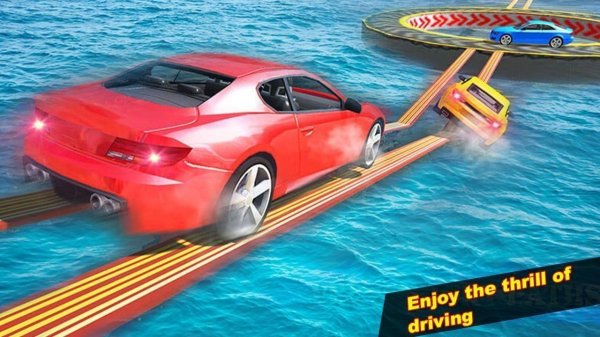
The game places players on routes suspended above the ground, weaving between buildings and industrial structures. These paths are constructed from shipping containers and metal platforms, creating a stark industrial aesthetic against the open sky. The elevated setting changes how players perceive speed and distance, as the drop on either side adds tension to every turn. Unlike conventional racing games where walls or barriers define the track edges, here the boundaries are often open air, making each run feel more precarious.
Vehicle Control and Balance
Steering inputs must be smooth and measured. Sudden jerks can send the car sliding off the edge, so gentle corrections become second nature over time. Acceleration and braking are equally important: speeding up too much on a narrow section may cause loss of control, while braking at the wrong moment can ruin momentum for an upcoming jump. The game encourages a patient approach, rewarding players who learn to modulate their speed through each segment.
Jump Mechanics and Gap Navigation
Several sections of each track are broken by gaps that require the vehicle to launch from one platform to another. The angle of approach and speed at takeoff determine whether the car lands safely or misses the target. These jumps are not random; each has a visual cue, such as a marked ramp or a change in surface color, that hints at the optimal launch point. Mastering these transitions is essential for maintaining speed and avoiding restarts.
Competition and Progression
Races pit the player against AI-controlled vehicles that follow the same physics rules. Opponents may take different lines through corners or attempt jumps at slightly different speeds, creating dynamic racing scenarios. As players advance, new tracks introduce tighter turns, longer gaps, and more complex sequences of obstacles. Success depends on learning each course's unique rhythm rather than relying on raw speed alone.
Practice and Skill Development
Replaying earlier levels helps build muscle memory for the most challenging sections. The game does not punish failure harshly; instead, it encourages repeated attempts to refine technique. Over time, players naturally improve their consistency, learning when to push the throttle and when to ease off. This gradual mastery creates a satisfying sense of progress, as once-difficult stretches become routine.









Comments
Sign in to comment
You must be logged in before posting a review or rating.
No account? Create one
No comments yet. Be the first to comment!